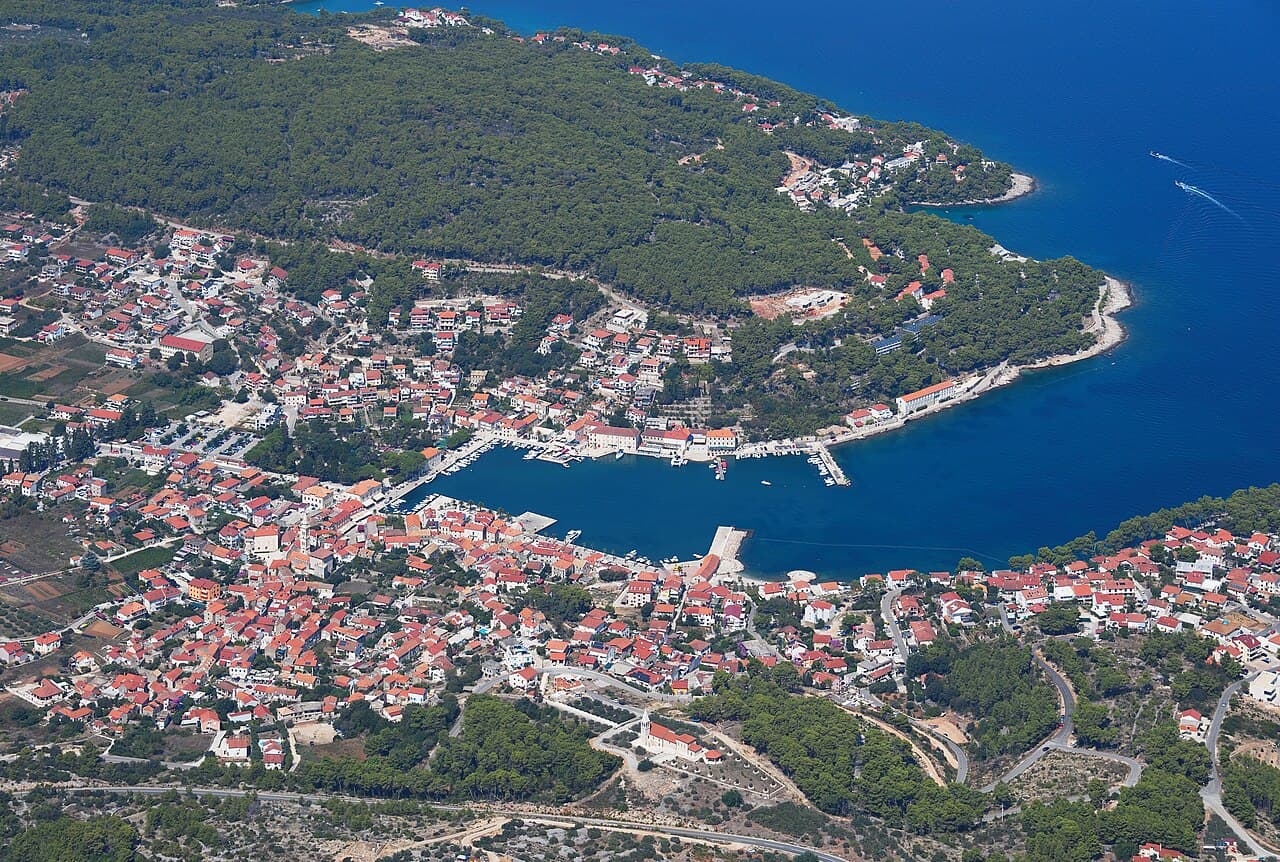
01Dog Beaches in Jelsa
Jelsa has one beach explicitly listed as a dog beach (plaža za pse): Gradina, about 1 km from the centre along the coastal footpath. The walk takes roughly ten minutes under tall pines. The beach is pebbly and rocky, and it is quieter than the town beaches.
The second favourite is Grebišće (also called Čorni Petar), a sandy cove close to town. Dogs have been welcome here for decades, and the designated dog area is large. Sand is rare on Hvar, so this is the best choice for dogs that dislike hard pebbles.
Other beaches on the Jelsa side of Hvar
The local tourist board lists these as pet-friendly beaches, provided the dog is under control:
- Vrboska, the village beaches.
- Zavala, in the main bay of the village, on the far side of the tunnel.
- Ivan Dolac, just west of the main beach.
These are not fenced or marked with official dog zones. They are tolerated areas, so keep your dog on a lead when it is crowded and pick up after it. Zavala is popular with families with small children, so go early or late in the day.
Opinion: There is no need to chase far-off coves. Gradina and Grebišće cover almost every dog's needs within 2 km of the centre.
02Dogs in the Old Town, Restaurants and Shops
Jelsa's centre is small, flat and built around the harbour and the main square. Dogs on a lead are normal on the waterfront promenade. The paved lanes get very hot at midday in July and August, so walk on the shaded side or go in the morning and evening.
Many restaurants allow dogs on outdoor terraces, and the harbour-front terraces are the easiest option. Indoor dining is at the owner's discretion, and dogs are not allowed in food shops. Ask before sitting down, and bring a water bowl, because not every venue provides one.
03National Parks and Nature Areas
Jelsa has no national park nearby, and Hvar has none at all. The nearest national parks are on the mainland. National parks in Croatia generally limit or forbid dogs, so leave the dog with a sitter if a mainland park day is planned. On Hvar, hiking trails, the Stari Grad Plain (UNESCO) and the coast paths are open to dogs on a lead. Carry water, because the trails have almost no shade or springs.
04Ferries and Catamarans to Hvar
- Jadrolinija car ferries
- Small pets travel free in a carrier on your lap or under the seat. Dogs over 8 kg also travel free but must stay on the open deck. A muzzle and lead are required for dogs, except service dogs.
- Split–Stari Grad (line 635)
- About 2 hours, and about €8.40 per adult and €47.60 per car in the 2026 high season. From Stari Grad, Jelsa is about 15 km by road.
- Catamarans
- The rules are stricter. Some operators require dogs in carriers or deck boxes, with a fee and a reservation, while others require a muzzle and lead. Catamarans to Hvar Town do not carry cars, so they are the harder choice with a large dog. Confirm with the operator before booking.
The car ferry is the easiest option with a dog, and it is also the only way to take your own car.
05What Accommodation Charges for a Dog
Pet fees in Croatian holiday rentals usually run €10–20 per night or a flat €30–60 per stay. Some apartments charge nothing, and many hotels charge more. Always confirm the fee and any size limit in writing before booking. Choose a ground-floor apartment with a shaded garden or terrace if you can. Apartments in the Gradina direction are closest to the dog beach.
06Summer Heat and Best Months
July and August regularly reach 30–35 °C, and the pavement and pebbles are much hotter than the air. Never leave a dog in a parked car. Walk before 9:00 and after 19:00 and rest in the shade or in air-conditioning in between.
The best months for a dog are May, June, September and early October, when the sea is warm enough to swim, the paths are comfortable, and the beaches are less crowded. Ticks and sandflies are active in spring and summer, so use a tick preventive from the vet before departure.
07Vet Basics
Jelsa is a small town, so check where the nearest clinic is before you arrive. There is a vet practice in Stari Grad that treats large and small animals; ask your accommodation for the current contact. For emergencies out of hours, the larger clinics are in Split on the mainland. Bring a basic first-aid kit and your dog's usual medication and food.
08EU Pet Passport Rules for Driving In
For dogs from EU countries, Croatia requires three things:
- An ISO microchip (15-digit), implanted before the rabies vaccination.
- A valid rabies vaccination, given at least 21 days before travel for a primary dose.
- An EU pet passport issued by an authorised vet.
Border checks are rare since Croatia joined Schengen in 2023, but spot checks are allowed. Keep the passport within reach. Dogs from non-EU countries need an animal health certificate, and a rabies titre test may be needed from countries such as Serbia and Montenegro. A passport costs about €10 plus VAT at a Croatian vet, and much more elsewhere.
09Verdict: How Dog-Friendly Is Jelsa?
Jelsa is very dog-friendly. It has an official dog beach within a 10-minute walk, a sandy cove, flat walking routes, a tolerant restaurant scene and an easy car-ferry route. The weak points are summer heat, a lack of vets in town and the lack of a fenced dog zone. It suits a calm, outdoor holiday much better than a busy party resort such as Hvar Town. Visit in late spring or September and it is one of the easier Dalmatian islands to take a dog to.

