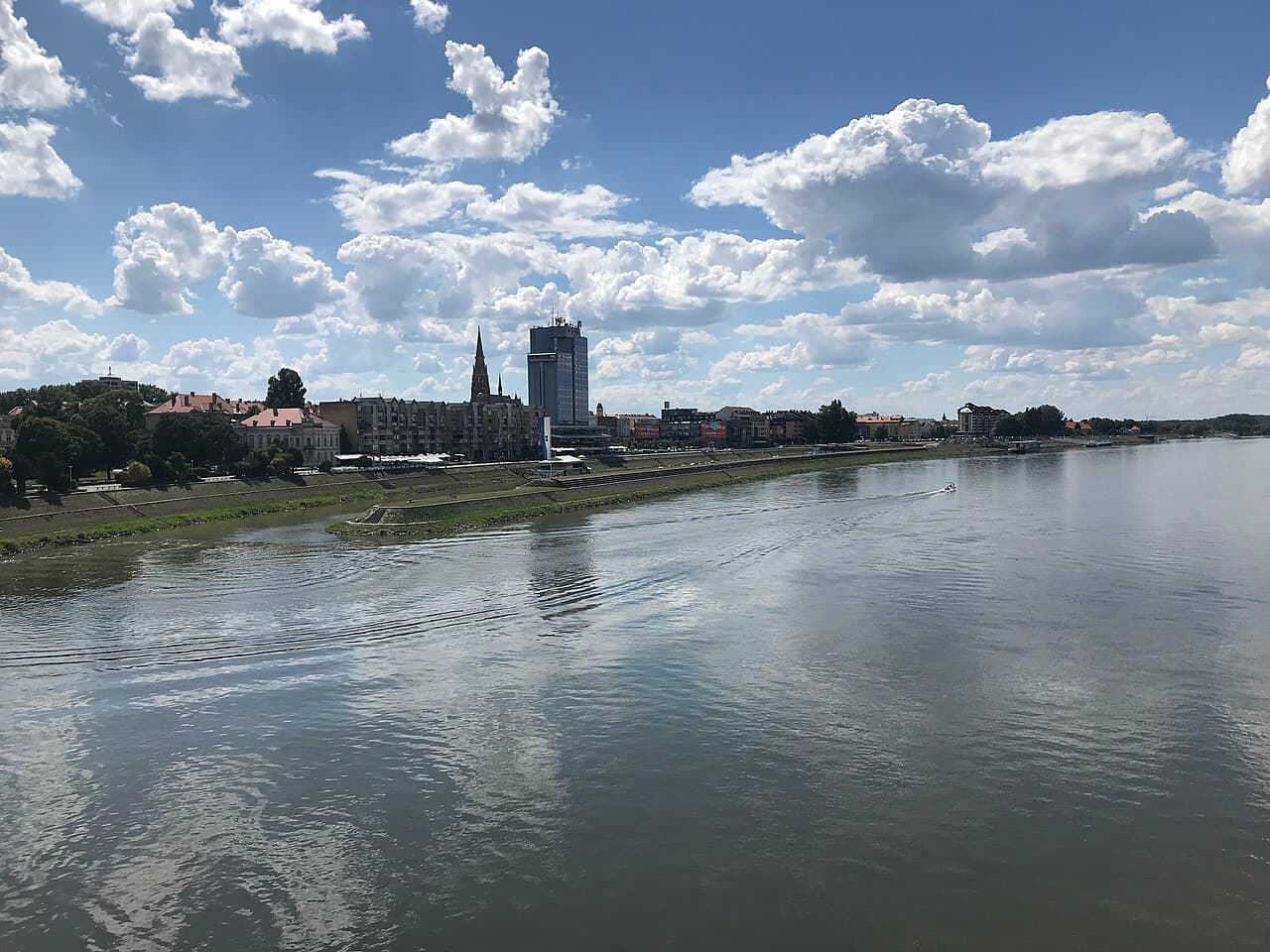
Osijek is divided into distinct neighborhoods strung along the southern bank of the Drava River. The city's linear layout, connected by a more than 140-year-old tram network and a continuous riverside promenade, means that choosing where to stay dictates your daily reliance on transport and access to specific amenities.
01Gornji Grad (Upper Town): The Commercial and Administrative Center
Gornji Grad is the primary downtown area of Osijek. Anchored by Ante Starčević Square and the towering 90-meter spire of the Co-cathedral of St. Peter and Paul, this district contains the highest concentration of retail stores, corporate offices, and transit connections.
Gornji Grad is objectively the most practical neighborhood for stays of 48 hours or less. It eliminates the need for public transport to reach 80% of the city's commercial venues and offers direct access to the central tram exchange where Lines 1 and 2 intersect. The neighborhood boundaries generally run from the main train and bus stations in the south up to the Drava River in the north.
Who Should Stay Here
- First-time visitors
- Immediate proximity to main landmarks and the tourist information center.
- Business travelers
- Close to municipal buildings, banks, and conference facilities.
- Transit-dependent travelers
- The main bus and railway stations are located at the southern edge of this district (a 10-15 minute walk from the main square).
Pros and Cons
Pros:
- Direct access to the Promenada (riverside walkway) and its cafes.
- Excellent tram and bus connectivity.
- The widest variety of dining options, ranging from fast food to high-end restaurants.
Cons:
- Street parking is limited and strictly enforced via paid zones (Zone 1 costs €0.60/hour or €8 for a daily ticket).
- Higher average accommodation prices compared to the eastern and western suburbs.
Recommended Accommodations in Gornji Grad
- Hotel Osijek (4-star)
- Located directly on the river promenade, 300 meters from the main square. It features a wellness center on the 14th floor with views of the Drava. Prices typically range from €110 to €140 per night.
- Hotel Waldinger (4-star)
- Situated on Županijska street, 250 meters from the cathedral. Known for its traditional aesthetic and on-site patisserie. Expect to pay €90 to €115 per night.
- Hostel OS
- A central budget option located right off the main square. Offers both dormitory beds (around €25/night) and basic private rooms (around €40/night).
02Tvrđa: The Historical and Nightlife District
Located 1.5 kilometers east of Gornji Grad, Tvrđa is Osijek's Old Town. Built in the 18th century as a Habsburg military fortress, it is characterized by cobblestone streets, Baroque architecture, and large historical squares, notably Holy Trinity Square (Trg Svetog Trojstva).
During the day, Tvrđa operates as an educational and cultural hub, housing several university faculties, the Museum of Slavonia, and the local government headquarters. On Friday and Saturday nights, the dynamic completely shifts. Kuhačeva street becomes the epicenter of Osijek's nightlife, packed with bars, clubs, and late-night food vendors.
Who Should Stay Here
- Nightlife enthusiasts: You can walk directly back to your room from the bars without needing a taxi.
- History and architecture focused travelers: Immersive historical environment.
- Couples: The cobblestone streets and historic facades offer a romantic setting.
Pros and Cons
Pros:
- Unique historical atmosphere not found in other parts of the city.
- Steps away from top-rated traditional restaurants serving Slavonian cuisine (such as kulen, fiš paprikaš, and čobanac).
- Close to the eastern pedestrian bridge leading to the Copacabana swimming complex on the northern river bank.
Cons:
- Noise levels are high on weekends. If you are a light sleeper, avoid rooms directly facing Kuhačeva street.
- Cobblestone streets make rolling heavy luggage difficult.
- Limited grocery stores within the fortress walls.
Recommended Accommodations in Tvrđa
- Boutique Hotel Tvrđa (4-star)
- Modern interiors housed in a restored historic building. Offers an intimate setting with an on-site spa area. Rooms range from €95 to €120 per night.
- B&B Maksimilian
- A highly rated bed and breakfast featuring a quiet interior courtyard, located just off the main squares. Provides a quiet retreat despite being in the nightlife district. Prices average €70 to €90 per night.
03Donji Grad (Lower Town): Quiet, Budget-Friendly, and Residential
Donji Grad stretches eastward from Tvrđa. It is a largely residential neighborhood with a slower, more local pace. The district is centered around Ban Jelačić Square and features its own local green market (pijaca), a hospital complex (KBC Osijek), and a quieter section of the riverside promenade.
This area is structurally different from Gornji Grad and Tvrđa. Buildings are predominantly single-family houses or low-rise apartment blocks. Accommodation here is heavily skewed toward private apartments and small family-run guesthouses rather than large hotels.
Who Should Stay Here
- Budget travelers
- Accommodation prices drop by 20-30% compared to the city center.
- Long-term visitors
- Easy access to supermarkets, local markets, and residential amenities.
- Families seeking quiet
- Minimal traffic noise and proximity to large green spaces like the Zrinjevac park area.
Pros and Cons
Pros:
- Cost-effective lodging, with many apartments available under €60 per night.
- Free or cheaper street parking (mostly Zone 2 or unzoned residential streets).
- Authentic local neighborhood feel, free from tourist crowds.
Cons:
- Requires a 30-40 minute walk or a 10-minute tram ride to reach the main square in Gornji Grad.
- Very few late-night dining or entertainment options.
Recommended Accommodations in Donji Grad
- Local Apartments
- The market is dominated by private rentals. Look for highly-rated apartments near the Lower Town square (Trg bana Josipa Jelačića) or along the eastern Promenada. Expect to pay €45 to €65 for an entire apartment.
- Sobe (Guesthouses)
- Several private room rentals operate along Vukovarska street, offering basic amenities for €35 to €50 per night.
04Retfala: The Western Suburb and Sports Hub
Retfala is the large neighborhood located to the west of Gornji Grad, connected to the center by Strossmayerova street—a long, straight avenue carrying Tram Line 1. Historically a quiet residential district, Retfala has seen significant development due to the construction of Opus Arena in the Pampas area. Opened in 2023, this 13,000-seat stadium is the home of NK Osijek and the most modern football facility in Croatia.
Who Should Stay Here
- Sports fans
- The closest neighborhood to Opus Arena for football matches.
- Travelers with vehicles
- Accommodation here frequently includes secure, private parking yards.
- Equestrian visitors
- Near the local hippodrome and western green areas.
Pros and Cons
Pros:
- Easy navigation and immediate access to western exit routes toward highways.
- Spacious accommodations, often with gardens or large balconies.
- Superb local bakeries and mid-range restaurants along Strossmayerova street.
Cons:
- Too far to comfortably walk to Tvrđa (a 4-kilometer distance).
- The main avenue (Strossmayerova) can experience heavy traffic congestion during rush hour or match days.
Recommended Accommodations in Retfala
- Apartments near Opus Arena
- A cluster of new, modern apartments has emerged near the stadium. These cater to weekend sports tourists and generally cost €60 to €85 per night.
- Guesthouses along Strossmayerova
- Convenient for those who want to step out their door and immediately board the tram to the city center.
05Essential Logistics for Your Stay
Public Transportation
Osijek is one of only two cities in Croatia (alongside Zagreb) with a tram network.
- Line 1
- runs east-west from Višnjevac (past Retfala) through Gornji Grad, ending in Zeleno Polje (Donji Grad).
- Line 2
- runs north-south, connecting the central square to the train station and the southern neighborhoods like Mačkamama and Bikara.
A single ride ticket costs €1 if purchased at a kiosk, or slightly more if bought from the driver.
The Promenada
The best way to navigate between Gornji Grad, Tvrđa, and Donji Grad on foot or by bicycle is the Promenada. This paved path runs uninterrupted along the Drava River. Walking from the main square in Gornji Grad to Tvrđa along the river takes exactly 15 to 20 minutes and bypasses all vehicle traffic.
Local Insider Tip: Mosquito Season
A critical factor when booking accommodation in Osijek is the summer mosquito season, which runs from late May through August. Because the city borders the massive Kopački Rit wetlands and the Drava River, mosquito activity is intense. When booking accommodation during these months, confirm that the property has intact window screens and functioning air conditioning. Relying on open windows for cooling at night is not viable during peak summer.
Seasonal Price Fluctuations
Accommodation prices in Osijek remain relatively stable compared to Croatian coastal towns, but slight spikes occur during two key periods:
- December: Osijek hosts a highly popular Advent festival, often centered in Tvrđa or city parks. Weekend rates increase by 15-20%.
- Early Autumn (September): Wine festivals and the Pannonian Challenge (extreme sports festival) drive up demand for short-term rentals.