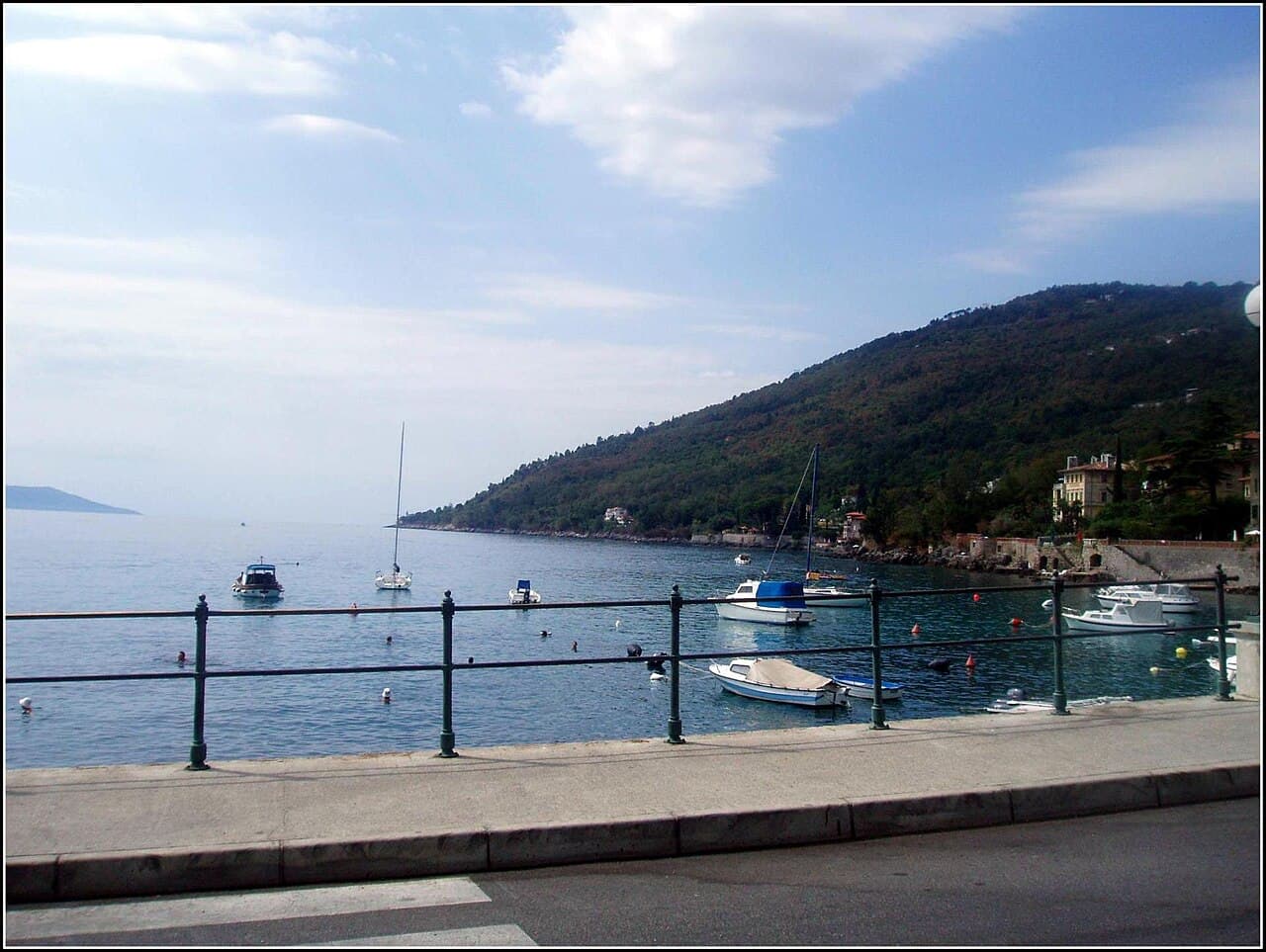
Lovran is one of the oldest coastal settlements on the eastern coast of the Istrian peninsula, located on the Opatija Riviera in Croatia's Kvarner Gulf. Unlike larger resort towns, Lovran offers a compact, highly walkable layout that transitions from a medieval core to seaside promenades and steep mountain slopes. Choosing where to stay within Lovran determines your daily experience—from parking access and beach proximity to the type of architecture you will sleep in.
This guide covers the distinct neighborhoods and micro-areas within Lovran's town limits to help you choose the best location for your trip.
01Understanding Lovran's Geography
Lovran sits at the foot of Mount Učka, meaning the town rises sharply from the Adriatic Sea. The main coastal road (State Road D66) runs directly through the lower section of town, separating the flat waterfront areas from the steep residential hillsides.
Accommodations below the main road or immediately on it offer flat walking routes to the center and the sea. Accommodations located even just 300 meters inland often require climbing steep staircases or winding roads. The town can be divided into four main accommodation zones: the Old Town (Stari Grad), the Lungomare North (towards Ika), the Peharovo Beach area to the south, and the Uphill Residential Zones.
021. Lovran Old Town (Stari Grad)
Best for: History, dining, couples, and short stays.
The Old Town is the historic heart of Lovran, originally surrounded by defensive walls. Today, it is a dense network of narrow cobblestone streets, small squares, and tall stone houses centering around Trg Sv. Jurja (St. George's Square) and the 12th-century Romanesque bell tower.
Staying inside the Old Town provides immediate access to Lovran's best restaurants, such as Konoba Knezgrad, as well as cafes, bakeries, and the daily open-air market located just outside the former town gates. The accommodation here consists almost entirely of private apartments, guesthouses, and rooms rented out by locals. There are no large hotels inside the medieval walls.
Skip paying a premium for sea-view upgrades if booking a room inside the historic Old Town walls. The medieval streets are extremely tight, meaning your upgraded view will likely be a stone wall or a neighboring roof. Save your money for a seafood dinner at a local konoba instead.
Pros of Staying in the Old Town
- Atmosphere
- You are sleeping in buildings that are hundreds of years old.
- Convenience
- Everything you need, from grocery stores (Plodine) to pharmacies and the main bus stop, is within a 3-minute walk.
- Dining
- Immediate walking distance to traditional taverns and wine bars.
Cons of Staying in the Old Town
- No Parking
- Cars cannot enter the Old Town. You will have to park in the paid municipal lots (like the Brašćine lot, costing roughly €1.30 per hour or €13 per day) and carry your luggage over cobblestones.
- Accessibility
- Many apartments are on the second or third floors of historic buildings with no elevators and steep, narrow stairways.
- Noise
- In July and August, the narrow streets echo the sounds of late-night diners and early-morning delivery trucks.
032. Lungomare North (Towards Ika)
Best for: Luxury, romantic getaways, and direct sea access.
North of the Old Town center, Lovran stretches along the famous Lungomare—a 12-kilometer coastal promenade connecting Lovran to Opatija. The Lovran section of the Lungomare is highly sought after for accommodation.
This area is characterized by grand, 19th-century Austro-Hungarian villas built as summer residences for the Viennese elite. Many of these historic properties have been converted into high-end boutique hotels (like Boutique Hotel Villa Astra) or luxury private apartment rentals. There are also a few larger resorts here, such as the 4-star Hotel Excelsior.
Accommodations in this zone usually sit directly on the waterfront or just across the coastal road. The coastline here is rocky, featuring concrete sunbathing platforms equipped with metal ladders that drop directly into the clear, deep water of the Adriatic.
Pros of Staying on the Lungomare North
- Direct Sea Access
- Many villas and hotels have private or semi-private concrete platforms for swimming immediately in front of the property.
- Architecture
- Staying in a restored Austro-Hungarian villa offers high ceilings, ornate balconies, and large Mediterranean gardens.
- Walking
- You can step out of your accommodation directly onto the flat, paved Lungomare for morning runs or evening walks.
Cons of Staying on the Lungomare North
- Price
- This is the most expensive area in Lovran. Peak summer rates for seaside villas easily exceed €250 to €400 per night.
- No Traditional Beaches
- If you prefer sand or pebbles to concrete slabs and deep water, this area is less ideal.
043. Peharovo Beach Area (South Lovran)
Best for: Families with young children, beach-focused trips.
Heading south from the Old Town center (about a 10-minute walk along the coastal road), you reach Peharovo. This is Lovran's main municipal beach and one of the best family beaches on the Opatija Riviera. Peharovo is a Blue Flag beach featuring a mix of pebbles on the shore and sand in the shallow waters, surrounded by a dense canopy of pine trees that provides natural shade.
The neighborhood directly above and around Peharovo consists of modern apartment buildings, guesthouses, and a few specialized hotels, such as the Boutique Hotel Acacia.
Pros of Staying in the Peharovo Area
- Family-Friendly Swimming
- The gradual entry into the sea and the pebble beach make it safe for small children, unlike the deep-water concrete platforms to the north.
- Shade and Facilities
- The natural pine shade means you do not have to rent umbrellas every day. The beach also has showers, changing cabins, and a beach bar.
- Quieter Environment
- It is removed from the busier Old Town traffic and transit hubs.
Cons of Staying in the Peharovo Area
- Distance to Center
- It requires a 10 to 15-minute walk along the main road to reach the supermarkets, pharmacies, and historical sites in the town center.
- Limited Dining
- Aside from a beach bar and one or two hotel restaurants, you will need to walk to the center for a wider variety of dining options.
054. Lovran Hillside & Upper Residential Zones (Brajdice, Opric)
Best for: Budget travelers, hikers, travelers with cars, and long-term stays.
Directly above the D66 coastal road, Lovran's residential neighborhoods climb the lower slopes of Mount Učka. Areas like Brajdice, Opric, and the lower stretches toward Liganj offer modern apartment rentals and holiday homes.
When booking accommodation here, pay close attention to the map. A listing that says "300 meters from the sea" might be true in a straight line, but that distance will involve a steep uphill climb on the way back from the beach.
Pros of Staying on the Hillside
- Panoramic Views
- Because of the steep elevation, apartments in this zone offer expansive, unobstructed views of the Kvarner Gulf, Krk Island, and Cres Island.
- Value for Money
- Prices drop significantly the higher up the hill you go. You can often rent a spacious two-bedroom apartment with a balcony for the price of a small hotel room on the coast.
- Parking
- Most hillside apartments and holiday homes come with guaranteed private parking spaces.
- Proximity to Nature
- You are closer to the trailheads leading into Učka Nature Park.
Cons of Staying on the Hillside
- Car Dependency
- While walking down to the beach takes 10 minutes, the walk back up in 30-degree Celsius (86 Fahrenheit) summer heat is exhausting. Having a car is highly recommended for grocery runs.
- Distance from Nightlife
- You will likely need to drive or take a taxi into town for dinner if you prefer not to hike back in the dark.
06Accommodation Types in Lovran
Historic Villas
Lovran is famous for its architecture. Staying in a historic villa is a premium experience. These properties are heavily concentrated along the Lungomare and just north of the center. Many operate as boutique hotels offering breakfast, manicured gardens, and private parking. Expect to pay €200 to €450 per night during the high season (July and August).
Hotels
Lovran has a handful of traditional hotels, mostly rated 3 or 4 stars. Hotel Excelsior is the largest, featuring indoor and outdoor pools, making it a reliable choice for resort-style amenities. Hotel Park and Hotel Lovran offer mid-range options closer to the town center. Standard hotel rooms range from €100 to €250 per night, depending on sea views and season.
Private Apartments (Sobe / Apartmani)
The most common accommodation type in Lovran is the private apartment. You will see blue signs reading "Apartmani" or "Sobe" (rooms) on houses throughout the town. These range from basic studio setups in the Old Town to luxury modern penthouses on the hillsides. Prices are highly variable, starting around €60 per night in the shoulder season for a basic hillside room, up to €200 per night for a modern apartment near Peharovo beach in peak summer.
07Practical Information for Booking
When to Book
Summer is the dominant tourist season. If you plan to visit between June 15 and September 15, book at least four to six months in advance.
Lovran also hosts the popular "Marunada" (Chestnut Festival) across three weekends in October. During these weekends, accommodations fill up quickly with domestic tourists and visitors from neighboring Slovenia and Italy.
Public Transportation
If you choose an accommodation in the Old Town, Lungomare, or Peharovo, you do not need a car. The local bus line (Bus 32) connects Lovran directly to Opatija, Rijeka, and the nearby village of Mošćenička Draga. The bus runs frequently (roughly every 30-40 minutes during the day) and costs €2 per ride. The main bus stop is located centrally outside the Old Town near the Plodine supermarket.